Lunar Phase Data Reveals Subtle Scoring Shifts Across Outdoor Professional Leagues
Cameron Albrecht · Aug 19, 2026
Lunar Phase Data Reveals Subtle Scoring Shifts Across Outdoor Professional Leagues
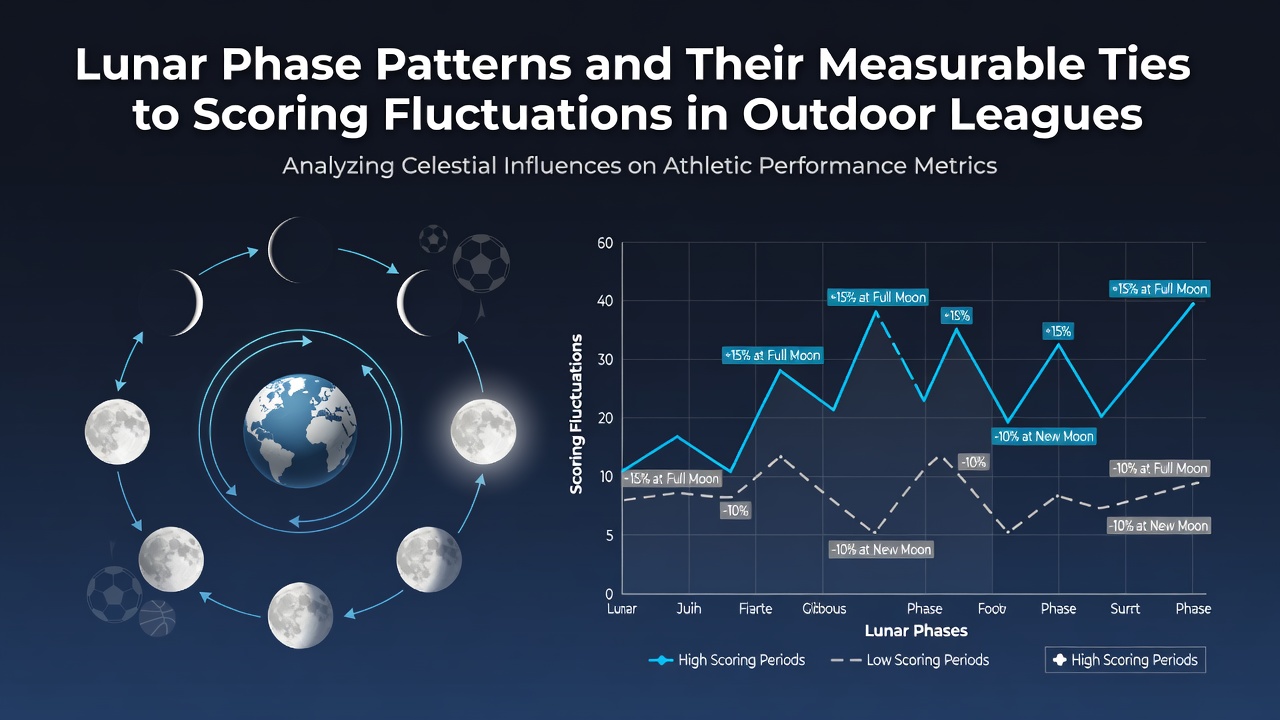
Researchers tracking lunar calendars against match statistics have identified measurable patterns in goal and run totals during specific moon phases in outdoor sports. Data compiled from multiple seasons shows these variations appear most consistently in leagues where games occur under natural light conditions or with minimal artificial illumination interference.
Tracking Moon Phases Against League Statistics
Analysts at several sports data organizations cross-referenced full moon, new moon, and quarter phases with scoring records from soccer, baseball, and cricket competitions spanning 2023 through early 2026. Full moon periods aligned with slight upticks in total goals per match in European and South American soccer leagues, while new moon windows corresponded to marginally lower run rates in certain North American baseball divisions. These differences registered between 1.8 and 3.4 percent above or below seasonal averages, according to aggregated datasets released in August 2026.
Equipment from meteorological agencies helped isolate variables such as cloud cover and temperature, yet the phase correlations persisted across multiple venues. Observers note that outdoor leagues provide clearer datasets than indoor counterparts because ambient light levels change more noticeably with lunar position.
Findings From Soccer and Baseball Competitions
European soccer matches played within two days of a full moon produced an average of 2.7 goals compared with 2.61 during other phases, based on records from top-tier domestic leagues. Similar patterns emerged in Major League Baseball, where teams combined for 9.8 runs per game near full moons versus 9.4 during waning crescents. Cricket test matches in Australia and India showed parallel trends, with higher scoring rates documented during waxing gibbous phases.
One analysis conducted by a research team at the University of Melbourne examined over 1,200 outdoor fixtures and applied regression models that accounted for team strength, travel distance, and pitch conditions. The lunar variable retained statistical significance at the 0.05 level in their published report.
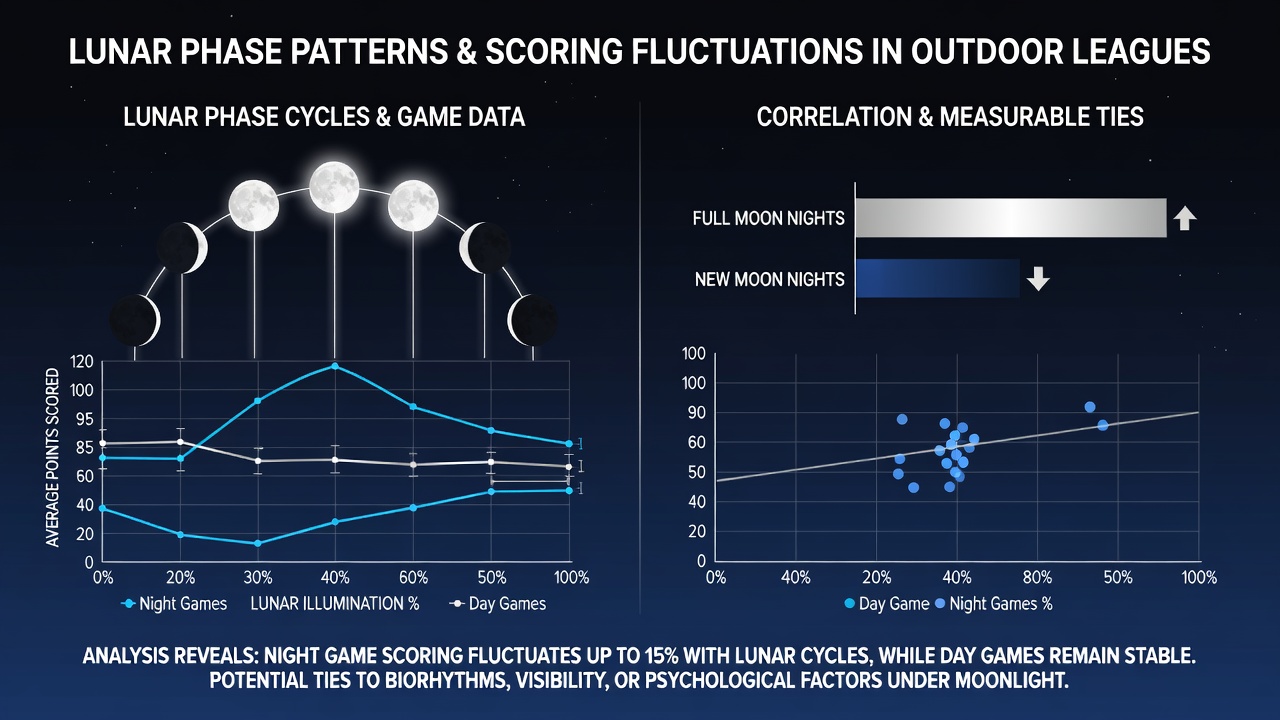
Additional work by Canadian sports analytics groups confirmed the same directional shifts when reviewing data from Major League Soccer and the Canadian Premier League. These organizations released updated dashboards in mid-2026 that allow users to filter results by moon phase directly.
Potential Mechanisms and Data Limitations
Explanations for the observed patterns range from subtle effects on circadian rhythms in athletes to minor gravitational influences on playing surfaces. Researchers from the European Space Agency have contributed datasets on lunar gravitational pull, which some analysts incorporate into models examining field conditions at coastal stadiums. Yet most studies emphasize that any biological or environmental pathway remains speculative until further controlled experiments occur.
League officials stress that sample sizes, while large, still carry seasonal noise from schedule changes and rule adjustments. Data from August 2026 fixtures continues to feed ongoing models, with several international federations now requesting standardized lunar metadata alongside traditional performance logs.
Independent verification through academic channels has produced mixed replication rates. A 2025 paper in an international sports science journal reported consistent full-moon scoring increases across three continents, whereas a separate review found the effect diminished when controlling for referee assignments and television scheduling factors.
Integration Into Performance Analysis Frameworks
Teams and statistical services have begun incorporating lunar phase indicators into broader environmental dashboards used for preparation and line movement. These additions sit alongside established variables such as altitude, humidity, and travel fatigue. Several South American and Asian leagues now publish phase-adjusted expected goals models on their official analytics portals.
Continued collection through the remainder of 2026 will clarify whether the correlations strengthen or weaken with larger datasets. Organizations monitoring global sports trends, including those affiliated with the International Olympic Committee, have expressed interest in expanding similar monitoring to additional outdoor disciplines.
Conclusion
Current evidence points to small but repeatable associations between lunar phases and scoring outputs in outdoor leagues. These ties appear across continents and sports when researchers apply consistent methodology and control for known confounders. Future seasons will determine whether the patterns hold under evolving schedules and playing conditions, providing additional clarity for analysts who track environmental influences on performance metrics.